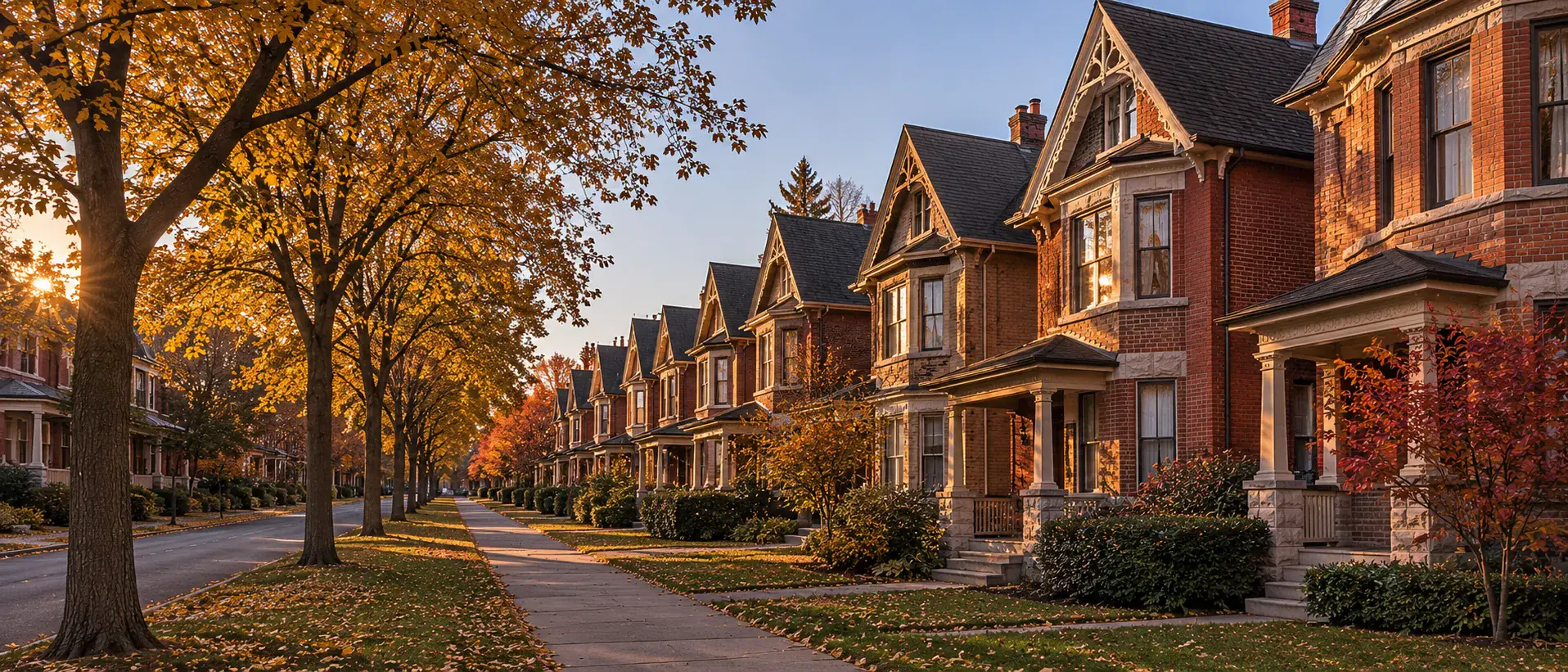
Real estate farming, done online: how Ontario teams own a neighbourhood
Farming still works. What changed is where homeowners do their research before they call anyone. Here's how to farm a neighbourhood where that research now happens.
· 7 min read
Real estate farming is choosing one area and marketing to it consistently, so that when homeowners there decide to sell, your team is the one they already know. The area is your farm. The idea is old, and it still works.
What has changed is where the deciding happens. Before a homeowner calls anyone, they look up what sold on their street. In Canada, "home value estimator canada" is searched about 1,000 times a month and "whats my home worth" about 140 times, before you count the searches for individual neighbourhoods and buildings (Google Canada search volumes via DataForSEO, October 2026). A farm that only exists in mailboxes misses all of it.
This guide covers how farming has traditionally worked, how to choose a farm with search in mind, and what an online farm looks like for an Ontario team.
How farming has traditionally worked
Most farming advice, much of it written for the US market, comes down to a handful of tactics:
- Mail: postcards, just-sold and just-listed notices, quarterly market reports.
- Door knocking and calls: direct, personal, and slow.
- Events and sponsorships: the community garage sale, the school fundraiser, the hockey team jersey.
- Signs: every listing in the farm is an ad for the next one.
These build familiarity, and familiarity is what farming is for. Their shared weakness is that they reach every household equally. A postcard goes to the family that just moved in and the couple who will list next spring, and you can't tell which is which. Costs grow with the number of doors, and the results are hard to trace back to the card that earned them.
What changed: the research moved online
A homeowner thinking about selling usually wants one answer first: what did homes like mine, near me, actually sell for? Asking prices are easy to find. Sold prices are not, and that gap is why sites that show them attract so much traffic.
In the GTA, that research mostly lands on consumer portals such as HouseSigma, Zolo and realtor.ca. The homeowner gets their answer, and the team that has farmed the area for years never learns they were looking.
Online farming puts your team in that moment. When someone searches their neighbourhood's sold prices, the page they find is yours, and to see the full sold history they register with your team.
Choosing a farm with search in mind
The traditional tests for a farm still apply. Add one more: can you be found there?
1. Turnover
Turnover is the share of homes that sell each year:
Turnover = sales in the last 12 months ÷ homes in the farm
A farm where homes rarely change hands gives you few chances, however well you market it. TRREB publishes sales by area every month in its Market Watch report, which is a good starting point for comparing candidates.
2. Value per sale
The same effort in a farm with higher prices earns more per listing. As a sample: one extra listing at $1,006,409, the GTA average selling price in September 2026 (TRREB), at a 2.5% listing-side commission, is about $25,000 in gross commission. Your commission and split will differ; the point is to know what one listing is worth before deciding what the farm can justify.
3. Search demand
Look at what people search about the area: the neighbourhood name with "homes for sale", "sold prices" or "real estate", the main streets, the condo buildings, the schools. A farm with no searches can still be farmed by mail, but it won't produce leads online.
4. Search competition
Search those terms yourself and note who ranks. If the first page is all national portals, you'll need a sharper focus, such as one building, one property type, or one part of the neighbourhood. If the results are thin, old or generic, that's your opening.
5. Your existing presence
Listings you've sold there, people you know, a history in the community. Online farming works faster where you already have something to say.
What an online farm is made of
An online farm has three parts: a site focused on the farm, pages that answer its searches, and a reason to register.
A site for the farm
Your team site covers everything you do. A farm site, or portal, covers one area and nothing else. That focus is what lets it rank: every page, link and article on it is about that neighbourhood, which makes it a stronger answer for that neighbourhood's searches than a broad site can be.
A portal can carry its own name and domain, owned by your team. The GTA team in our case study runs four, each focused on a different farm.
Pages that answer the farm's searches
Listing pages alone rarely rank, because an IDX feed puts the same listing text on every site that carries it. The pages that rank are the ones no feed provides:
- A community overview: what the neighbourhood is like, its housing stock, its price range, how it has changed.
- Sub-area and street pages: the pockets within the farm, which often have very different prices.
- Building pages for condo farms: one page per building, with its amenities, fees and history.
- Schools and parks: searched constantly by families deciding where to buy.
- A monthly market update: what sold, what's for sale, and what changed, from a cited source.
Written well, these are useful to a reader and specific enough to rank. They're also content that only someone who knows the area can write, which is the advantage a local team has over a national portal.
A reason to register
Traffic only becomes a lead when the visitor leaves a name. On a VOW (virtual office website), a brokerage can show sold prices and listing history from the board, but only to visitors who register: they give a name and a valid email address and accept the board's terms of use.
That rule does the work a postcard can't. A homeowner who registers to see what sold on their street has told you they're interested, and the registration can tell you which street they were looking at. Instead of mailing every door, you know which doors to knock on.
Mail and online work better together
Online farming doesn't replace the mailbox. It makes it measurable.
A just-sold postcard that says "See what else sold on Maple Avenue this year" with a short link or QR code to that street's page sends people to your portal, where they can register. The card does what it always did, build familiarity, and now you can count who responded.
The same goes for signs, door hangers and event flyers. Every offline touch can point to one page for the farm.
Ontario rules to build in from the start
Two sets of rules shape an Ontario farm site:
- RECO advertising requirements. Team websites count as advertising, and RECO's Bulletin 5.1 requires the brokerage name, as registered with RECO, to appear clearly and prominently. A portal with its own name still carries the brokerage's.
- Board data rules. Showing sold data on a VOW requires a data agreement between your brokerage and TRREB, along with its display rules. If a vendor runs the site, your brokerage designates them as its Affiliated VOW Partner.
Follow-up has rules too. Email to people who register falls under Canada's Anti-Spam Legislation (CASL), so ask for consent at registration and include a way to unsubscribe in every message.
None of this is legal advice, and board policies change. Check the current rules with your brokerage before you launch.
How long it takes
Farming has always been slow, and online farming is no exception. A focused neighbourhood portal usually takes three to six months to rank for its farm's searches. Registrations start at launch and grow as it climbs.
That timeline is the reason to start narrow. A portal for one neighbourhood can rank in months. A site aimed at a whole city can take years, if it gets there at all.
What to measure
Postcard farming is judged on feel. An online farm can be judged on numbers:
- Search visibility: in Google Search Console, the impressions and clicks for your farm's searches, month over month.
- Registrations: how many people signed up, and for which streets.
- Conversations: how many registrations became a call or a meeting.
- Listings: the result that matters, traced back to where the relationship started.
Review them monthly. If a page ranks but nobody registers, the offer behind registration needs work. If nothing ranks, the farm may be too broad or too contested.
Where to start
Pick one farm, the one where you already have the most to say. Look at its searches and who answers them. Then build the pages a homeowner there would want, and give them a reason to register.
If you'd like help with the first step, tell us the farm. We'll send the searches, their monthly volume and who ranks for them today.